
In the movie Limitless, Bradley Cooper stumbles upon a secret drug called NZT-48, which unlocks the full capacity of his brain and gives him superhuman intelligence, attention, and reasoning abilities. This lets him crank out complete books in days, learn Italian overnight, and beat the stock market. Sounds awesome, right?
There is no such thing as NZT (not even close, really), but that doesn’t mean there aren’t legitimate ways to squeeze some more juice out of your brain. Some pharmaceuticals, as well as more natural methods exist that can make you think faster, improve your memory, enhance your concentration, or just otherwise help you get things done more effectively.
This is a very extensive topic, and my intention is to cover it thoroughly, from multiple angles. Why am I writing this in the first place? Well, I’m pleased to inform you that I will be starting a PhD program (in Information Assurance, otherwise known as cybersecurity, in case you were curious), so I am expecting the need to beef up my brain power soon. This means that I will likely be rather busy over the coming years, so A) let’s learn how to hack our brains, together; and B) I may be writing even less often, so my apologies for that.
This article will begin by diving into the subject of metacognition – thinking about thinking – and exploring a model for how people can become experts at the skill of learning. Next, I will explore some productivity hacks for both academic and professional purposes, including techniques for greatly improving your memory. A discussion of how to maintain an optimal cognitive environment via nutrition and other lifestyle factors will follow. Finally, some of the pharmaceuticals that may enhance cognition will be presented.
Metacognition, Cognition, and Becoming an Expert
Metacognition, which can be loosely defined as “thinking about thinking”, is one of the primary factors that separates the true brainiacs from the merely intelligent. It has been heavily studied, particularly with a focus on how to teach metacognitive skills to children. For some great overviews of this material (highly recommended if you are a teacher or otherwise work with children), see Hartman 2001 and Papaleontiou-Louca 2003.
But I’m an adult, and your probably are as well. How can we use our understanding of metacognition to improve ourselves and our ability to learn things? One approach is to model the metacognitive principles that make someone an “expert” at whatever they do, and use that model to create our own cognitive strategies. To that end, I turn to a paper that I cannot recommend highly enough to interested readers (Ertmer and Newby, 1996). I believe that having exposure to this model and some understanding of it is enough to make yourself a better learner, though practice using it would surely benefit. In any case, here’s what an expert learner looks like (emphasis mine throughout quotations):
“In 1988, Glaser and Chi listed and described seven key characteristics of expert performance that previous research had uncovered. Weinstein & Van Mater Stone (1993) have summarized these characteristics succinctly: ‘experts know more; their knowledge is better organized and integrated; they have better strategies and methods for getting to their knowledge, using it, applying it, and integrating it; and they have different motivations. Moreover, they tend to do things in a more self-regulated manner‘ (p. 32). Experts are described as being more aware of themselves as learners; their learning is ‘reflected upon more than is the learning in which others engage’ (Berliner 1994: 162). In addition, experts are thought to be more sensitive to the task demands of specific problems, as well as more opportunistic and flexible in their planning and their actions (Berliner 1994). As a result, experts are more aware than novices of when they need to check for errors, why they fail to comprehend, and how they need to redirect their efforts (Brown & DeLoache 1978).”
Being an expert in some area involves more than simply having direct knowledge of the subject matter; while that is important, experts must also be conscious of what they are doing and recognize the right approach to take for a given task. Specifically, in addition to knowledge about the subject, expert learners employ metacognitive knowledge in these other ways:
“Weinstein & Van Mater Stone (1993) indicate that expert learners strategically utilize four different types of knowledge to bring about successful learning: knowledge about selves as learners (e.g., What are my strengths? What time of day is best for me? What are my current study habits?); knowledge about learning tasks (e.g., What does this task require for successful completion? How will performance on this task be evaluated?); knowledge about a wide variety of strategies (e.g., What cognitive strategies would facilitate the recall of this information? What can I do to keep my motivation high? What obstacles in the environment must be removed or sidestepped?); and knowledge about content (What do I know about this topic?). In addition, an expert learner has the ‘skill, will, and a systematic approach to studying and learning’ (Weinstein & Van Mater Stone 1993: 35) which make strategic learning not only possible, but probable as well.”
These kinds of knowledge manifest themselves in the general approach that expert learners take towards their learning.
“Before beginning a specific learning task, expert learners tend to consider a variety of ways to approach the task. They access their knowledge warehouses to recall past experiences with similar tasks and select an approach which matches task requirements and personal resources in such a way that the desired results can be obtained. Effective learners have a plan (either in their minds or on paper) that details how they expect to accomplish their goals. While executing the task, they constantly reflect on this plan to assess the extent to which it is working and then revise or modify it as necessary. As a result of this continuing reflection, expert learners make constant on-line adjustments, eliminating extraneous steps, implementing alternative strategies, and/or performing unplanned actions whenever necessary.”
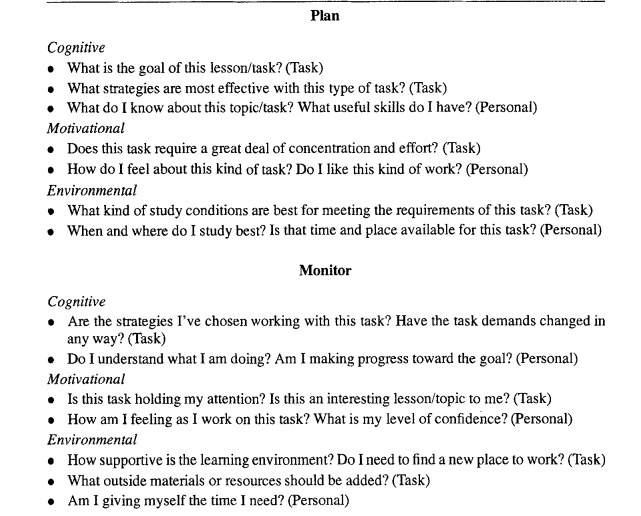
Essentially, an expert learner goes about their learning in three steps:
- Planning the best way to achieve their goals;
- Monitoring their performance and adjusting the plan as necessary;
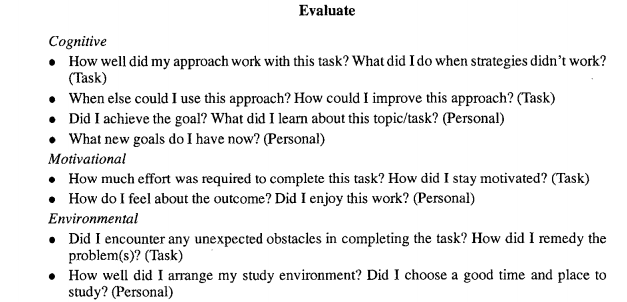
- Evaluating/Reflecting upon the learning experience in order to gain more metacognitive knowledge that can be put to use in the future.
There are also three primary areas where this metacognitive process is used for strategic effect, related to the types of knowledge mentioned above.
- Cognitive – use of mnemonics, outlining or notetaking strategies, etc.
- Motivational – setting goals, positive or negative reinforcement, etc.
- Environmental – scheduling time for the task, finding the right place to do it, etc.
Each of these metacognitive knowledge areas can and should be considered during each of the phases of learning. In other words, you should plan out your cognitive, motivational, and environmental strategies, monitor how each of these strategies is working, and then reflect upon the results in each of these areas.
How do expert learners go about the planning phase?
“Before beginning a task, expert learners must consider three things: 1) the task demands (e.g., type and length of the material to be learned); 2) their own personal resources (e.g., knowledge of and skill at using various strategies); and 3) potential matches between the two (e.g., mnemonics vs rehearsal vs outlining strategies for remembering the names of the Great Lakes). For example, if learners think that note taking and underlining are good strategies for identifying the main points of a technical article (task) and know that they are good at underlining but poor at taking notes (personal resources), the most effective match would call for underlining.”
…
“The activities involved in this step tend to resolve around three major tasks: setting a clear goal, selecting and sequencing a series of strategies and/or procedures for achieving the goal, and identifying potential obstacles to the successful attainment of the goal. It is important to note that the strategies/procedures selected must include not only the appropriate cognitive strategies (e.g., outlining, memorizing, analogizing, etc.) but also the motivational (e.g., recalling previous successful performances, determining task relevance) and environmental strategies (e.g., removing distractions, forming work groups) which would be instrumental in completing the learning task.”
After implementing the plan, it is important to monitor how it is being executed.
“Throughout the execution of a learning plan, expert learners mentally check what they are doing to ensure that they are making progress toward the specified goal. Here the focus is on actually implementing the steps in the plan, while monitoring the effects of selected cognitive, motivational, and environmental strategies. This involves looking backward at the plan to determine if the necessary steps are being performed in the correct order, looking forward to the steps still to be performed, while carefully attending to what is going on at the moment (Beyer 1987). As expert learners complete each step in the plan they must consider how accurately and effectively it was accomplished and decide whether or not it is appropriate to move on to the next step. They need to pay attention to feedback regarding the effectiveness of their selected cognitive, motivational, and environmental strategies and make on-going revisions. If an obstacle is encountered, adjustments must be made, not only to remove the block but to decrease the possibility of it reoccurring at some later point.”
Finally, learners must reflect upon their learning session and the metacognitive strategies that were employed.
“Wilson & Cole (1991) indicate that the strategies of reflection and articulation (i.e., talking about one’s own knowledge, reasoning, or problem-solving processes) help to bring meaning to activities that might otherwise be more ‘rote’ and procedural. Without reflection, learners may not learn to discriminate in applying procedures, may fail to recognize conditions when strategies may be appropriate for use, and may fail to transfer knowledge and strategies to different tasks.”
The paper also provided a table that would be very helpful for anyone who wants to apply this model to their own learning. Use the questions included to guide you through the metacognitive process while you attempt to learn a new skill or subject. To practice, you should consider writing your answers to these questions down the next few times you set out to learn.
Hacking Your Productivity
Having the right metacognitive skills is important, but the effort will be greatly aided by having an arsenal of productivity techniques at your disposal. Your understanding of how you work and learn best isn’t worth much if you haven’t tried to work and learn in a variety of ways.
In this section, the focus will be on learning techniques that will allow you to work faster, smarter, and more efficiently.
Productivity Techniques
A lot of work has been done on the subject of being more productive. Entire systems, such as David Allen’s “Getting Things Done” method have been developed and promoted extensively. To learn more about various productivity frameworks and which ones work best for which kinds of people, I recommend checking out this reference. Here, I will only go over a few methods briefly, and then some of the most effective tips for staying productive during your day.
- Pomodoro technique. Set a timer for 25 minutes, and work hard without taking any breaks during that time. When the timer goes, off, take a 5 minute recovery break. Walk around, check Facebook, check some emails, grab a snack, do some pushups, or whatever would help you unwind for a few minutes. This thirty-minute cycle is one “Pomodoro”. Every four Pomodoros, take a longer break of 15-30 minutes in order to recharge. This is a great way of maintaining energy and focus over a period of time, and prevents you from getting too drained by constant work (or constant distractions).
- Don’t Break The Chain method. This is a technique that was popularized by Jerry Seinfeld, apparently, and helps you maintain positive habits over the long-term. You’ll need a calendar (preferably a full-year calendar), a marker, and a task that you wish to accomplish every day. For each day you accomplish that task, make a big “X” on your calendar for that day. As you go, you’ll be motivated to continue performing that task on a daily basis in order to not break the chain that begins to form after a few days. For more info on how to adapt this method to multiple goals/tasks and to incorporate things like sick days or vacations, see this.
- Kanban. Split your tasks into three categories: To Do, Doing, and Done. Use sticky notes, a whiteboard, or a digital organizer to break your work into tasks and visually place them into these three buckets. This is a simple way of maintaining a “to do” list that also helps you understand what you’ve already accomplished.
- Three most important things. At the end of each day, decide what the three most important tasks you must accomplish the next day are. Make sure these are the first things you do the next day, and don’t allow yourself to get distracted with other tasks before they are complete. Willpower is drawn from a limited pool, so as you use your willpower to stay focused, it becomes harder and harder to push yourself throughout the day – particularly as distractions and new tasks pop up.
- Must, Should, Want. This is a variant on the “most important things” method. Instead of doing the most important things, pick three tasks that fit into must, should, and want categories. In other words, pick a high priority task, a lower priority task that contributes to your long-term goals, and something that you would genuinely like to do (for fun, like reading a book).
These methods are not mutually exclusive; you should try them out and use your metacognitive skills to create your own hybrid method that works best – or that works best for the particular task at hand.
In addition to these methods, there are a number of techniques you can use to be more productive in general.
- Use the two minute rule. Any task that will take two minutes or less to complete should be done immediately. Don’t let it become a mental burden to carry throughout the day – simply get it done. For instance, if you need to send someone a spreadsheet, fill out a brief form, make an appointment, or anything else that can be done quickly, just do it right away. These kind of tasks can add up and make your mind cluttered, and you are likely to forget to do them if you wait.
- Take breaks to stand up and move around. Sitting all day is really bad for you, and moving around can help keep your mind and body fresh. Walk around or do some pushups at least once per hour. Better yet, get a standing desk.
- Use apps like Evernote to stay organized.
- Adopt a low-information diet. Have fewer daily readings, podcasts, news sites, and magazines that you visit for leisure. Cut down on email lists that you subscribe to (and use unroll.me to put all of your email subscriptions into one daily email). Watch less TV. Turn off your phone. Ask yourself if you really need to be getting that information regularly…you probably don’t. Be conscious of how much time you spend surfing the Internet, watching TV, or playing games. The RescueTime app can be very useful for this, as it documents how you are spending your time on the Internet. Use Instapaper or Pocket to save articles from the Internet that you don’t have time to read right now. For those who have a serious problem consuming too much info (myself included), you can use apps to block distracting websites, such as Cold Turkey for Windows, and Selfcontrol for Macs.
For more information on this (ironically throwing this in right after suggesting a low-information diet….), here is a long list of productivity tips, and here is a great article on how to have an uber-productive workday.
Learning Techniques
If the task at hand is of a more academic nature (this includes actually being in school, but also just trying to teach yourself new things), there are additional techniques that can be helpful. Keep in mind that the distinction between the “productivity” techniques above and these “academic” ones isn’t always clear – most likely, both will be useful to you in a variety of settings, academic or professional.
- Learn how to speed read, or just how to read significantly faster. This is a complex topic that I won’t delve into here, but you can find more information here, here, and here. There are people who are skeptical about speed reading as well, so a more moderate perspective on speed reading may be best.
- Use the SQ3R method for studying or reading new material. Survey: before reading the material, skim through the chapter, look at the headings/subheadings, and get a feel for how the author organized it. Question: ask yourself…what are the main points of the chapter? What are questions you may have about the subject before going into it? Read: read the chapter actively; highlight key words or concepts after you finish a paragraph. Recite: after every few pages, recite aloud the main points thus far. Review: review numerous times before an exam or needing to utilize the material. More info here.
- Speaking of reviewing, you should briefly review immediately after consuming new material. You should then rewrite or reorganize your notes on the material within 24 hours. Schedule a review of your notes one day, one week, one month, and several months after. This will help make sure you retain your new knowledge far in the future.
- Taking notes is important, and there are a variety of different note-taking strategies. I strongly recommend taking notes as you work through material and then retyping/rewriting those notes later that day. In order to see the connections between various ideas in the material more easily, use mind mapping. There is also the Cornell System of note taking: divide the page into a thin “cue” section on the left, a larger “notes” section on the right, and a two-inch summary section at the bottom. This helps keep your notes organized as you take them, so they don’t require as much reorganization later on.
Cal Newport’s blog is also a great resource for students, so spend a little time looking through his stuff for some more ideas.
Memory Training and Mnemonics

One particular area that is well worth developing is your memory. Some people have a better memory than others, but there are specific techniques that can be used to train yourself to remember huge amounts of material more easily.
These techniques are called mnemonics, and usually involve the association of information that you want to remember with vivid mental images that you create. These images should be in great detail and perhaps even be weird in order to make them more memorable. The mnemonic can contain senses other than sight, so associate smells, sounds, tastes, etc. with your mental picture. The association between the information you want to remember and the image should take center stage. The mnemonic can have a location (one image is “located” in Boston and another, similar image is located in New York City) so you can separate it from other, similar mnemonics. I’ll discuss a few kinds of mnemonic techniques shortly.
First, let’s take a quick detour. Some people find it hard to believe that memory can really be enhanced to a significant degree by using mnemonic techniques, but research clearly shows that impressive memories are possible. A brilliant paper (Dresler et al, 2012) on cognitive enhancement, which we will return to in the next section of this article, discusses mnemonics.
“Since the early 1990s, the top participants of the annual World Memory Championships regularly prove memory spans of hundreds of digits (Konrad and Dresler, 2010). However, such superior memorizers do not seem to exhibit structural brain changes or superior cognitive abilities in general, but acquired their skills by deliberate training in the use of mnemonic techniques (Brown and Deffenbacher, 1988; Maguire et al., 2003; Ericsson, 2009).”
Which kinds of techniques help foster such impressive memories?
“Parallel to their success in memory artistry and memory sports, several mnemonics have been shown to strongly enhance memory capacity in scientific studies (Bellezza, 1981; Worthen and Hunt, 2011a, 2011b). Probably most prominent is the so called method of loci, an ancient technique used extensively by Greek and Roman orators (Yates, 1966). It utilizes well established memories of spatial routes: During encoding, to-be-remembered information items have to be visualized at salient points along such a route, which in turn has to be mentally retraced during retrieval. A second powerful mnemonic is the phonetic system, which is designed to aid the memorization of numbers: Single digits are converted to letters, which are then combined to form words. Both the method of loci and the phonetic system have been shown to be very effective and even increase their efficacy over time, i.e. at delayed recall after several days compared to immediate recall (Bower, 1970; Roediger, 1980; Bellezza et al., 1992; Hill et al., 1997; Higbee, 1997; Wang and Thomas, 2000).”
In addition to mnemonics, practicing the retrieval of information also enhances memory.
“Another strategic method to enhance memory retention that has gained attention in recent years is retrieval practice. While retrieval of learned information in testing situations is traditionally thought to simply assess learning success, repeated retrieval itself has been shown to be a powerful mnemonic enhancer, producing large gains in long-term retention compared to repeated studying (Roediger and Butler, 2011). For example, when students have to learn foreign vocabulary words, repeated studying after the first learning trial had no effect on delayed recall after one week, while repeated testing produced a surprisingly large effect on long-term retention (Karpicke and Roediger, 2008). Besides vocabulary learning, also text materials profit from repeated retrieval (Karpicke and Roediger, 2006, 2010)…Effects of retrieval practice were even shown to produce greater success in meaningful learning than elaborative studying strategies, which are designed to lead to deeper learning and therefore hold a central place in contemporary education (Karpicke and Blunt, 2011).”
In other words, you should repeatedly test your memory in order to enhance it. Rather than studying material over and over, you would be better off attempting to remember the material you have already studied.
Convinced? Great! So, what kinds of mnemonics can you take advantage of?
- Acronyms and acrostics. Acronyms are where each letter represents a key word, and acrostics are where the first letter of key words form a sentence. These techniques are commonly used to remember information involving key words or vocabulary. For instance, to remember the order of operations in math, use PEMDAS, or Please Excuse My Dear Aunt Sally. This stands for parentheses, exponents, multiplication/division, and addition/subtraction.
- Rhyme keys. First, memorize key words that can be associated with numbers (one – bun; two – shoe, and so on). Next, create an image of the items you need to remember with key words. This method is useful for remembering ordered or unordered lists, such as a shopping list. If you need to remember milk and bread, for instance, create an image that involves buns and milk, and another image that involves shoes and bread. Remember, weird images are easier to remember, so it’s okay if the image doesn’t “make sense.”
- Number shape system. Similar to the above, but instead of rhymes, each number is associated with a shape that looks similar (1 – candle/spear; 2 – swan; 3 – bosom; 4 – sail; 5 – hook; 6 – club; 7 – cliff; 8 – sand clock time piece [sorry, not sure how else to describe it]; 9 – flag; 0 – egg).
- Chaining. Create a story where each word or idea that you intend to memorize is a cue for the next concept that you need to remember. An example from Wikipedia: “when memorizing the list (dog, envelope, thirteen, yarn, window), one could create a story about a “dog stuck in an envelope, mailed to an unlucky thirteen black cat playing with yarn by the window”.”
- Method of Loci, or the “Journey Method”. Imagine placing the items you want to remember in specific locations in a room that you are familiar with. Instead of using a room, you can use landmarks in a “journey” that you know well, such as the route to work, or the path from your bed to the front door. Remember many landmarks along this journey, possibly by writing them down and considering them as “stops” on the route. Then just associate what you need to remember with those landmarks that you already have a clear image of in your mind. This is good for both short and long term memory, but if used for long term, you should reserve a specific route in your mind for it and not “overwrite” those images. You can remember very long lists with this, if you have a sufficiently long journey.
- Names. To remember peoples’ names – something that is a common difficulty for many individuals – invent a relationship between the person’s name and some physical characteristics about the person. For instance, my name is Mike and I have a loud voice (microphone). This isn’t a great example because my voice isn’t a physical characteristic. But if I were short, you could associate my name with “micro”.
I’ve only scratched the surface of mnemonic techniques, but for those interested in exploring this further, start here and here.
Maintaining An Optimal Cognitive Environment

Up to this point, I have only discussed strategies and techniques that will make you a more effective learner and be able to accomplish more in less time. For the rest of this article, I will delve into the research about how you can actually become smarter; that is, ways to facilitate cognitive enhancement.
Primarily, this research centers on various lifestyle factors, such as exercise, sleep, meditation, and nutrition, which have been shown to improve assorted measures of cognition. Keep in mind that there are many different measures of cognition, and a ton of confounding factors that can influence the conclusions. There is also a lot of variation among individuals. As such, it’s not always clear that manipulating your lifestyle in a certain way will have a specific effect on a specific type of cognitive function; that being said, incorporating these factors into your lifestyle will likely make you smarter, more creative, and more focused.
Exercise
It should come as no surprise that exercise enhances cognitive function. After all, exercise is good for you, period. But what exactly does it do for your brain?
According to Dresler et al (2012),
“…brief bouts of physical exercise improved long-term memory in young adults (Coles and Tomporowski, 2008). Intense exercise in the form of high impact anaerobic running was shown to strongly enhance learning speed in a vocabulary memorizing task (Winter et al., 2007). A recent meta-analysis demonstrated that in particular mental speed and memory processes are consistently enhanced after acute exercise, while the effects during acute exercise seem to depend on the specific exercise mode. In general, however, cognition enhancing effects of acute exercise seem to be in the small to medium range (Lambourne and Tomporowski, 2010). Besides motivational factors, an increase in general arousal level related to physical exertion has been hypothesized as a potential mechanism (Brisswalter et al., 2002).”
In other words, high-intensity exercise performed before a learning task may help improve your ability to learn and remember.
There is also a substantial body of evidence demonstrating that a consistent exercise regime can enhance cognitive function, but the different types of exercise and measures of cognition employed in these studies limit our understanding. One interesting view is that long-term cardiovascular exercise essentially “primes” the brain for memory gains from acute exercise (Roig et al, 2013):
“Although long-term cardiovascular exercise does not improve memory significantly, the practice of regular bouts of exercise have a priming effect on the molecular mechanisms responsible for memory processing (Berchtold et al., 2005), thereby optimizing the response to a single bout of acute exercise and its effects on memory performance (Hopkins et al., 2012).”
In other words, most people will get a cognitive benefit from acute exercise, but those who have been exercising consistently beforehand will get an even larger benefit.
Sleep
An important function of sleep is to improve cognitive abilities. In particular, according to Dresler et al, sleep enhances both memory and creativity. The beneficial impact of sleep on memory has been scientifically validated for nearly 100 years.
“First empirical reports on the positive effects of post-learning sleep on memory consolidation were published almost a century ago: Jenkins and Dallenbach (1924) demonstrated that memory for nonsense syllables over retention periods including sleep is less prone to forgetting compared to an equivalent time of wakefulness. Since then, hundreds of studies testing different memory systems have confirmed the positive effects of sleep on memory consolidation (Diekelmann and Born, 2010).”
Obviously, getting a good night’s sleep is important in making sure you are on your game – cognitively speaking – the next day. If you are pressed for time, you can still get some memory boost by taking power naps during the day, whether you slept well the previous night or not.
“…a growing number of studies demonstrates that also additional sleep in the form of daytime naps benefits memory function in non-sleep-deprived subjects (e.g. Mednick et al., 2003; Korman et al., 2007). Of note, even a nap as short as 6 min has been shown sufficient to promote memory performance (Lahl et al., 2008), and for some memory systems the benefit of a daytime nap is comparable to a whole night of sleep (Mednick et al., 2003).”
Learn more about how to nap strategically to get the most benefits here.
Sleep also enhances creativity, as anyone who has come up with a brilliant idea while asleep knows.
“Anecdotal reports on scientific discovery, inventive originality, and artistic productivity suggest that also creativity can be triggered or enhanced by sleep. Several studies confirm these anecdotes, showing that sleep promotes creative problem solving compared to wakefulness. For example, when subjects performed a cognitive task, which could be solved much faster through applying a hidden rule, after a night of sleep more than twice as many subjects gained insight into the hidden rule as in a control group staying awake (Wagner et al., 2004). Like sleep-related memory enhancement, active processes during sleep seem to promote creativity: If applied during sleep, olfactoric stimuli that were associated with creativity tasks before sleep trigger insights overnight (Ritter et al., in press). In particular REM sleep, the sleep stage most strongly associated with intense dreaming, enhances the formation of associative networks in creative problem solving (Cai et al., 2009).”
Meditation
Meditation – another habit that I strongly recommend you adopt right away – leads to long-term gains in many areas of cognitive function. In particular, it leads to noticeable improvements in attention. According to Dresler et al,
“During recent years, the effects of meditation practice were systematically studied also in western laboratories, and a rapidly growing body of evidence demonstrates that meditation training enhances attention and other cognitive capacities. For example, in comparisons of experienced meditators with meditation-naive control subjects, meditation practice has been associated with increased attentional performance and cognitive flexibility (Moore and Malinowski, 2009; Hodgins and Adair, 2010). In longitudinal studies, three months of meditation training could be shown to enhance attentional capacity (Lutz et al., 2009), perception and vigilance (MacLean et al., 2010). Even a brief training of just four meditation sessions was sufficient to significantly improve visuo-spatial processing, working memory and executive functioning (Zeidan et al., 2010). A recent systematic review associated early phases mindfulness meditation training with significant improvements in selective and executive attention, whereas later phases were associated with improved sustained attention abilities. In addition, meditation training was proposed to enhance working memory capacity and some executive functions (Chiesa et al., 2011). A recent meta-analysis of the effects of meditation training reported medium to large effect sizes for changes in emotionality and relationship issues, medium effect sizes for measures of attention and smaller effects on memory and several other cognitive capacities (Sedlmeier et al., in press).”
Learn more about meditation’s benefits and how to get started meditating here.
Computer Training – Overhyped
In recent years, brain training games and programs have become big business online. Unfortunately, research is mixed with respect to the efficacy of these programs. There is definitely some potential, but it doesn’t appear that the improvements that result from computer training transfer to other domains, so I cannot recommend this as a useful strategy. Dresler et al again:
“Much interest has been focused on enhancing long term memory or brain plasticity in healthy or mildly impaired older adults using training programs, especially to prevent dementia and age related cognitive decline (Cotelli et al., 2012; Tardif and Simard, 2011). Computerized training programs have shown moderate improvements of memory that are sustained 3 months after end of training (Mahncke et al., 2006). Other studies have found improvements in memory and attention (Smith et al., 2009; Zelinski et al., 2011), executive function and processing speed (Nouchi et al., 2012; Basak et al., 2008) and working memory and episodic memory in young and older adults (Schmiedek et al., 2010). However, a large six-week online study did not find evidence for transfer (Owen et al., 2010). Also, although computerized brain training games have become a major industry it is not clear that the commercial games transfer to untrained tasks (Fuyuno, 2007; Ackerman et al., 2010).”
…
“Computer games appear to be able to train visual skills, such as visuo-spatial attention, number of objects that can be attended and resolution of visual processing (Achtman et al., 2008; HubertWallander et al., 2011). Playing the game Tetris improved mental rotation and spatial visualization time (Okagaki and Frensch, 1994), and computer game training improved contrast sensitivity (Li et al., 2009), spatial visual resolution (Green and Bavelier, 2007) and taskswitching (Strobach et al., 2012). However, these enhanced abilities, although not tied directly to the gaming task, might nevertheless be limited to similar domains. For example, a study found that games enhance navigation performance in desktop and immersive virtual environment but not real environments (Richardson et al., 2011).”
If you have a particular interest in trying these programs, go for it. It might work. But you are probably better off spending your time and money on something else.
Nutrition
What you eat can have a dramatic impact on your cognitive function. This is true both acutely and over the long-term. A healthy diet can help ensure that your brain is functioning at its optimal level, but you can also alter your food choices in order to improve your cognitive function in the hours that follow your meal.
One of the most commonly overlooked factors in your cognitive ability is your hydration status. Being dehydrated has all sorts of nasty physical and cognitive effects. Most health experts recommend the 8×8 rule; that is, consuming eight 8-ounce cups of water per day. But not only is maintaining adequate hydration necessary, but acute water consumption can also improve visual sustained attention, short-term memory, simple reaction time, and mood (Masento et al, 2014). As such, I recommend keeping water close by at all times.
Food choices can have a profound impact on your cognitive function – just think about how sluggish you feel after Thanksgiving dinner. A very thorough review by Gibson and Green (2002) dives into the details. Despite it being often recommended that people eat breakfast, it is unclear whether skipping breakfast has a cognitive impact on children or adults. Most likely, breakfast is beneficial with respect to some areas of cognition and is detrimental in others. Lunch, on the other hand…
“…a quite consistent finding has been a drop in performance after the midday meal, known as the ‘post-lunch dip’ (Folkard & Monk, 1985; Smith & Kendrick, 1992; Owens et al. 2000). It appears that performance on tasks requiring sustained attention are more likely than briefer tasks of selective attention to be attenuated by lunch (Christie & McBrearty, 1979; Smith & Miles, 1986b). However, it remains unclear to what extent the ‘post-lunch dip’ actually depends on eating lunch (Folkard & Monk, 1985); an underlying rhythm in performance also seems likely to contribute, since vigilance was worse in the early afternoon than late morning, in subjects not eating lunch (Smith & Miles, 1986a).”
In other words, you should avoid doing the most cognitively demanding tasks in the early afternoon. A siesta would be a better choice, if you can swing it.
Dieting appears to have a psychological impact that decreases cognitive performance.
“Dieting has also been associated with impaired cognition (Wing et al. 1995). For example, female dieters performed more poorly than non-dieters on a task of sustained attention (Rogers & Green, 1993), as well as poorer performance on immediate free recall and simple reaction time tasks (Green et al. 1994). In addition, this study found that motor performance (as assessed by two-finger tapping speed) was actually better in dieters than non-dieters, indicating that these effects could not be explained in terms of a simple slowing of overall motor speed or lack of motivation amongst dieters. Further, performance has been demonstrated to be poorer, within the same individuals, when dieting than when not dieting (Green & Rogers, 1995), indicating that the phenomenon is related to dieting per se, rather than pre-existing individual differences between dieters and non-dieters. Interestingly, this study is notable for two further aspects. First, the impairments in performance were found even amongst those dieters who reported not having lost any weight over the course of the diet and, second, that the impairments were most marked in those who had been dieting for the shortest period of time. These two factors combine to suggest that the dieting-related phenomenon is psychological, rather than physiological in nature.”
In other words, you shouldn’t be “going on a diet” if you want to maintain optimal cognitive function. I use scare quotes to help draw the distinction between “dieting” and merely eating healthy, which may include significant calorie reduction (or even intermittent fasting). My suspicion is that those who view themselves as “on a diet” will suffer performance reductions, whereas those who engage in exactly the same behaviors (say, eating dramatically less) but view it as a normal part of their healthy lifestyle will not lose cognitive function – and may even gain some.
What about the effects of meal composition? What impact do the specific components of your meal have on your cognitive abilities?
Let’s start with cholesterol. While the reigning health dogma screams “cholesterol is evil!!!” there are many, such as myself, who disagree. And for the purposes of our discussion here, it seems that having lower cholesterol levels (and/or attempting to lower them) may negatively impact cognitive function. This is likely due to the critical role that cholesterol plays in maintaining the lipid bi-layer of the brain.
“…a number of studies indicated that low or decreasing levels of cholesterol are associated with increased rates of death from suicide (for example, see Gallerani et al. 1995), incidence of depression (Glueck et al. 1994) and impaired cognitive function (in terms of choice reaction time; Benton, 1995). There is also some cross-sectional data to suggest that higher cholesterol levels are associated with better cognitive function (Muldoon et al. 1997).”
The amount of fat in a meal likely has little effect on cognitive performance other than making you a little more tired.
“On balance, high-fat meals appear likely to increase subsequent fatigue and reduce reported alertness, but with little effect on cognitive performance, relative to high-carbohydrate–low-fat meals. However, there were inconsistencies relating to changes in specific moods and effects of meal timing.”
Things get more interesting with carbohydrates (glucose). From a general health perspective, I would recommend consuming a low-carb diet. And by following a low-carb, high-fat diet, your brain will be healthier due to decreased inflammation, and you will probably have better cognitive performance. Nevertheless, it does appear that a meal that is high in carbohydrates is likely to stimulate improved cognitive performance in the short term. According to Dresler et al,
“Hypoglycemia, i.e. when the blood glucose level falls to very low values, can affect cognitive functioning negatively and is associated with slower reaction times in task that require attention. In healthy individuals, however, the blood glucose level appears to be fairly stable during the day. Subjective reports of “increased mental energy” have been associated with higher glucose metabolism in the brain (Posner et al., 1988; Reivih and Alavi, 1983), and this effect occurs within several minutes after glucose administration. With regard to objective cognitive performance, glucose improves attention (Benton et al., 1994), response speed (Owens and Benton, 1994) and working memory (Scholey et al., 2001), the latter occurring under conditions of high but also under low glucose depletion (Owen et al., 2012; Jones et al., 2012). The most pronounced effects of glucose on cognition are found for declarative memory (Messier, 2004; Smith et al., 2011), where effect sizes in the large range have been demonstrated in particular for demanding tasks (e.g Sünram-Lea et al., 2001, 2002a, 2002b; Meikle et al., 2004). High blood-glucose level are associated with improved memory function (Benton and Owens, 1993), and glucose administration before and after learning similarly improves memory performance, indicating that attentional or other non-memory specific processes during encoding alone cannot be responsible for the memory enhancing effects of glucose (Sünram-Lea et al., 2002a). Memory effects are more pronounced in elderly as compared to young adults, and glucose tolerance was predictive for declarative memory performance (Manning et al., 1990; Meikle et al., 2004; Messier, 2004).”
A high carb meal might be just the ticket before tackling a difficult task…just don’t make it a habit.
Unlike carbs, increasing dietary polyphenol consumption is something you should make a habit of. Polyphenols such as those from red wine, cocoa, berries, nuts, coffee, and tea have cognitive benefits that are likely due to neuroprotective mechanisms unrelated to their antioxidant activity (Lamport et al, 2012).
“Evidence suggests that consuming additional polyphenols in the diet can lead to cognitive benefits, however, the observed effects were small. Declarative memory and particularly spatial memory appear most sensitive to polyphenol consumption and effects may differ depending on polyphenol source. Polyphenol berry fruit juice consumption was most beneficial for immediate verbal memory, whereas isoflavone based interventions were associated with significant improvements for delayed spatial memory and executive function…polyphenol consumption has potential to benefit cognition both acutely and chronically.”
You may want to consider increasing your consumption of lutein too – it is important in improving vision as well as cognition (Johnson 2014).
“Examination of a relationship between cognition and lutein levels in brain tissue of decedents from a population-based study of adults found that, among the carotenoids, only lutein was consistently associated with a wide range of cognitive measures that included executive function, language, learning, and memory, which are all associated with specific brain regions. The association of lutein with more than one cognitive function, the higher lutein concentrations in all areas of the brain evaluated, and the fact that these associations remained statistically significant after controlling for potential confounding factors all support a role for lutein in age-related cognitive health.”
How much lutein do you need?
“…in a double-blinded, placebo-controlled trial of women who received lutein supplementation (12 mg/d), docosahexaenoic acid supplementation (800 mg/d), or a combination of the two for 4 months, verbal fluency scores improved significantly in all 3 treatment groups. Memory scores and rates of learning improved significantly in the combined treatment group, who also displayed a trend toward more efficient learning.”
Aim for 12 mg/day. This is difficult to do via diet alone, but possible if you incorporate high-lutein foods, such as leafy greens (kale is the true powerhouse, but spinach is good too), brightly colored fruits, and egg yolks. You can view the top sources of dietary lutein here.
Omega-3 Fatty Acids
Omega-3 fats are so important, I felt they deserved their own section, even though technically they could fall under “nutrition”. After all, you can get significant amounts of omega-3’s by eating fatty fish (such as salmon) and walnuts regularly. However, you can get more substantial benefits by taking a fish oil supplement (particularly one that is high in DHA).
A recent review article looked at the randomized controlled trials of omega-3 supplementation and how it improves cognition, with encouraging results (Stonehouse 2014). In summary:
“Current evidence suggests that consumption of LC [long chain] omega-3 PUFA, particularly DHA, may enhance cognitive performance relating to learning, cognitive development, memory and speed of performing cognitive tasks. Those who habitually consume diets low in DHA, children with low literacy ability and malnourished and older adults with age-related cognitive decline and mild cognitive impairment seem to benefit most. ”
The effects are slightly different in different age groups.
“The outcomes that were improved with LC omega-3 PUFA supplementation in children included verbal learning and memory, reading, spelling, non-verbal cognitive development and processing speed, visual-perceptive capacity, attention and executive function; in younger adults memory and reaction time of memory were improved; and in older adults several studies showed improvements in memory, while executive function and visuospatial learning were also improved.”
Before you decide to supplement with fish oil, you should check with your doctor. It is a very powerful anticoagulant, so it is contraindicated with certain medications and diseases.
Creatine
You may think of creatine as a supplement for meatheads, or perhaps that it is dangerous for your kidneys. In reality, it is one of the most well-researched supplements that is incredibly safe (there is no evidence of kidney damage, but it elevates the levels of creatinine in urine, which is often used to test for kidney disease) and beneficial for a wide range of uses. Eating meat provides your body with creatine, but it is easier to achieve optimal levels through supplementation.
For our purposes here, what matters most is that it is strongly neuroprotective and generally good for your brain. Interestingly, it seems to be helpful for women battling with depression. It also aids in cognitive function and alertness in sleep-deprived or stressed individuals. You can read all about the research on creatine here.
A recent review of research on creatine and psychiatric disorders had this to say about the impact of creatine on cognitive function (Allen 2012):
“In human intervention studies, most placebo-controlled, double-blind studies reported positive findings. In healthy volunteers, creatine supplementation reduced mental fatigue following a stressful time-pressured serial calculation test (Watanabe et al., 2002). Additionally, creatine improved working memory and intelligence scores in vegetarians and vegans, who are more likely to have diminished phosphocreatine reserves due to limited meat consumption (Rae et al., 2003). In non-vegetarians undergoing significant sleep deprivation paired with mild exercise (> 24 hours), creatine improved mood and reduced fatigue and performance decline on a choice reaction task (McMorris et al., 2006). In a follow-up study, creatine supplementation enhanced performance on central executive and working memory tasks after 36-hours of sleep deprivation (McMorris et al., 2007a). In older adults (~76 years of age), creatine buffered age-related cognitive decline, with improvement in verbal and spatial short-term memory and long-term memory after one week of daily supplementation (McMorris et al., 2007b). Most recently, adults supplemented with creatine exhibited better short-term memory and trended towards better abstract reasoning than placebo controls (Hammett et al., 2010).”
While the jury is out on whether creatine will truly improve cognitive function in non-elderly, non-sleep-deprived individuals, it is certainly plausible. And given its neuroprotective (and many other) benefits, its safety, and its price (a six month supply can cost as little as $15), there is little reason not to add it into your life. By the way, go with creatine monohydrate rather than any of the other “fancy” forms that creatine can come in – it is cheaper and the most well-researched.
Caffeine
As discussed in my previous post about the benefits of coffee, caffeine is seriously good for your brain. Not only can it dramatically reduce the risk of Parkinson’s and Alzheimer’s Diseases, but caffeine can also improve cognitive function in healthy individuals. Caveat: it’s possible that the cognitive benefits are just a reduction in withdrawal symptoms of caffeine, but there is debate about this.
In any case, a very interesting review article (Nehlig 2010) explored the potential of caffeine to enhance cognition.
“It has been repeatedly demonstrated that caffeine decreases reaction time, increases vigilance and attention, and has positive effects on mood (at the doses used in most studies that will be considered here).”
In addition, caffeine appears to enhance passive learning, but not intentional learning. It might help you learn things incidentally, but caffeine before your study session probably won’t do much. That being said, caffeine can be exceptionally beneficial to those who are sleep-deprived or otherwise tired.
Remember, coffee isn’t the only good source of caffeine. Green tea is one of the healthiest things on the planet and also has some. And if, despite the cognitive benefits, you are trying to quit caffeine, this guide can help.
Nootropics And Pharmaceutical Approaches To Cognitive Enhancement

A “nootropic” is a drug or supplement that improves cognitive function in healthy individuals – like the fictional NZT in Limitless. Obviously, a nootropic as powerful as NZT doesn’t exist, but there are plenty of promising substances that can still improve things like memory, executive function, attention, and motivation in healthy individuals.
Much more human research needs to be done in this area. Some individuals experiment with loads of these compounds, and there is a ton of anecdotal evidence that they can be beneficial. Some people take “stacks” of multiple substances in order to enhance the effects. There are quite a few nootropics, but I will only cover a few of the more popular ones here.
Piracetam And The –Racetam Family
Racetams are a structurally similar class of compounds that are related to Piracetam and are often marketed as cognitive enhancers and usually sold over-the-counter. Most racetams are extremely safe and nontoxic, but may result in uncomfortable side effects such as headaches.
There is quite a bit of anecdotal evidence that Piracetam and other racetams enhance cognition, but the data isn’t yet clear on what exactly these compounds do, particularly in healthy individuals. That being said, research has shown that they do have neuroprotective properties, and they are sometimes used clinically to protect the brain from trauma and cognitive deterioration, such as that which can occur after a heart bypass surgery. See Malykh and Sadaie (2010) for a literature review on the clinical uses of many racetam drugs.
The most studied of these drugs is piracetam, which likely prevents cognitive decline, but has little evidence of enhancing cognition in healthy adults. Another popular one is aniracetam, which is considerably stronger than piracetam and appears to improve creativity and holistic thinking in users.
A number of racetams offer hope for safe and effective cognitive enhancement in healthy adults, but your mileage may vary.
Modafinil
Modafinil is a prescription drug and “wakefulness-promoting agent” used primarily to treat narcolepsy. It is safe for most individuals (though it is possible to have severe negative reactions) and highly nontoxic. It is also a rather promising cognitive enhancer (Battleday and Brem, 2015).
“…modafinil appears to exert a beneficial effect on executive functions, with some benefits seen in inhibitory control and working memory paradigms, and more marked effects in higher executive functions such as planning, decision making, and fluid intelligence.”
There are some qualifications, however. Modafinil appears to be more beneficial in aiding with more complex tasks than with simple ones, and in some cases, it may hinder cognitive performance.
“When simple psychometric assessments are considered, modafinil intake appears to enhance executive function, variably benefit attention and learning and memory, and have little effect on creativity and motor excitability. When more complex tasks are considered, modafinil appears to enhance attention, higher executive functions, and learning and memory. Negative cognitive consequences of modafinil intake were reported in a small minority of tasks, and never consistently on any one: decreased performance on a cognitive flexibility task (the intra/extra-dimensional set shift task in Randall et al. (2004)), increased deliberation time during harder trials on a planning task (the One-Touch Stockings of Cambridge task in Randall et al. (2005a, 2005b)), increased deliberation time on one divergent thinking task (the Cambridge Gambling Task in Turner et al. (2003)), and decreased performance on another (the abbreviated Torrance in Mohamed (2014)). It appears that modafinil exerts minimal effects on mood – if anything improving it – and only rarely causes minor adverse effects.”
Another important caveat is that modafinil appears to be more effective in individuals who have lower IQ scores (Randall et al, 2005). This means that more intelligent individuals won’t get as much of a cognitive boost as those who have more catching up to do – but it also means that some of the research on modafinil may understate the cognitive benefits. If experiments were done on groups with higher than average IQs, then the detection of the positive impact of modafinil may be limited.
Stimulants
There are a number of stimulant medications, usually prescribed for ADHD, that have been shown to have cognitive enhancing effects. This includes amphetamines (Adderall) and methylphenidate (Ritalin), which are commonly used (often illegally) by students who want to improve their focus and study harder in school.
A word of caution is in order here. First of all, these are controlled substances, so it will be illegal for you to use them without a prescription. Second, these medications have some abuse potential and may have some negative impact on health. That being said, they are used on a daily basis by many individuals over long periods of time and are usually well tolerated.
Research clearly shows that these drugs can enhance cognition in healthy, non-ADHD individuals. For instance, in a review of nearly sixty studies, single doses of methylphenidate were found to improve cognitive function in a number of domains (Linssen et al, 2014).
“The studies reviewed here show that single doses of MPH [methylphenidate] improve cognitive performance in the healthy population in the domains of working memory (65% of included studies) and speed of processing (48%), and to a lesser extent may also improve verbal learning and memory (31%), attention and vigilance (29%) and reasoning and problem solving (18%), but does not have an effect on visual learning and memory. MPH effects are dose-dependent and the dose–response relationship differs between cognitive domains.”
Another review and meta-analysis was performed, looking at studies of modafinil, methylphenidate, and amphetamine use in non-ADHD youth, ages 12-25 (Bagot and Kaminer, 2015).
“Modafinil appears to improve reaction time (P ≤ 0.04), logical reasoning (P ≤ 0.05) and problem-solving. Methylphenidate appears to improve performance in novel tasks and attention-based tasks (P ≤ 0.05), and reduces planning latency in more complex tasks (P ≤ 0.05). Amphetamine has been shown to improve consolidation of information (0.02 ≥ P ≤ 0.05), leading to improved recall. Across all three types of prescription stimulants, research shows improved attention with lack of consensus on whether these improvements are limited to simple versus complex tasks in varying youth populations.”
Methylphenidate improves a number of cognitive domains, but appears to be more effective when performing unfamiliar tasks and may even hinder performance on tasks that are more routine.
“Methylphenidate also appears to have some effect on higher-order cognitive processes; however, there seem to be environmental and task limitations. Declarative memory, cognitive flexibility and increased response time and accuracy on auditory tasks show improvements for up to 4.5 hours after methylphenidate ingestion. Also, improvements in spatial tasks utilizing skills of planning and adaptation and memory have been shown in novel situations. Methylphenidate appears to have a dual but contradictory effect on cognitive enhancement such that it improves performance in unfamiliar tasks, but results in a deficit in planning latency and increased impulsivity leading to poorer performance in familiar tasks. Indeed, novelty appears to influence cognitive effect, as those who take methylphenidate may be better able to shift attention to unfamiliar characteristics of stimuli with fewer errors in task response. Additionally, there may be up to a 10% improvement in conscious error awareness without a concomitant change in response speed.”
Amphetamines seem to enhance learning ability, making them a useful study aid.
“Amphetamine may enhance knowledge acquisition and coding of information, as well as ability to retrieve information. However, these processes may, again, be limited by stimuli characteristics and medication half-life. Studies have shown that acoustic and semantic information may be encoded and accessed more easily with amphetamine. Temporally, amphetamine should be taken prior to learning; the hour after knowledge acquisition may be the most crucial for consolidation; recall may be most noticeably improved 1–3 days following the initial learning event; and recognition of previously learned information may be maximized 1 week following learning. Those with lower baseline functioning in insightful problem-solving, semantic retrieval and non-verbal intelligence may be aided by amphetamine in these domains.”
Interestingly, despite the cognitive benefits of these stimulant medications, it doesn’t appear that their use improves actual academic outcomes in those who have ADHD – actual study behaviors may be more important (Advokat and Scheithauer, 2013). Why?
“To address that question we considered some non-cognitive behavioral effects of stimulants on mood and motivation. We found evidence that stimulants reduce frustration, improve self-regulation, and increase effortful behavior, and that the drugs’ euphoric effects do not necessarily impair attention. However, all of these actions would facilitate academic performance and would not explain the discrepancy.
On the other hand, we also found evidence that stimulants “promote risky behavior” and may increase the interfering effect of environmental distractions. Results concerning risky behavior might be reinterpreted as evidence of stimulant-induced “inflexibility,” or “cognitive stereotopy,” which have been recognized for a long time (Robbins and Sahakian, 1979). Nevertheless, it may be that some students, either consciously or not, use these effects to their advantage. For example, the “inflexibility” that may be induced by stimulants might be put to good use by promoting a consistent, habitual, study schedule. Perhaps stimulant-induced facilitation of episodic memory does benefit ADHD students with good study habits. Alternatively, the drugs may not have much benefit if students use them to stay up longer the night before exams, or to write papers at the last minute.”
In other words, stimulant medications are unlikely to be a “magic pill” for cognitive enhancement. To actually improve academic outcomes, you’ll need to implement the metacognitive strategies discussed in the first section of this article.
“These data suggest that the GPA disparity between ADHD and non-ADHD students could be eliminated if ADHD students were able to develop well-established study habits. The results imply that the drugs alone are not sufficient to overcome the disadvantage of not preparing for exams. Unfortunately, it is not clear from these data alone if taking stimulant medications actually helps ADHD students to do that. That is, do the stimulant drugs help students to plan ahead, or to begin studying ahead of time so that they can compensate for their cognitive deficit? If so, why didn’t more of the ADHD students do that?”
…And More!
As discussed at the beginning of this section, there are far more nootropics than I can possibly cover here, though I’ve tackled the most important ones. If you are interested in getting a feel for the state of the research on assorted pharmaceutical neuroenhancers, these two papers by the same author should get you started (Fond et al, 2015; Fond et al, 2015). Over the coming years and decades, some of those substances may fall into wider use.
It is important to note that there are many issues with attempting to study the cognitive effects of various drugs (Husain and Mehta, 2011). There are many different cognitive domains, and different substances act in different ways and influence these domains in different ways. Some substances may improve a few domains and have negative effects in others. There is also a huge variability in the response of different individuals to these drugs, so even if there is some statistical benefit on average, your results may be far better…or worse. And it is likely that certain subgroups will benefit more than others; for instance, as discussed under the modafinil section, those with lower IQ or baseline cognitive function likely benefit more than those who are already high-functioning.
As such, be very careful if you are considering experimenting with nootropics. Keep your expectations in check.
Summary/Conclusion
Becoming more productive and a more effective learner is something within reach of everyone, and there are many strategies you can use for this purpose.
First, you’ll want to make sure you approach the task at hand in an optimal way. This requires the development of metacognitive skills, which will allow you to improve your ability to learn. These skills include the ability to plan, execute, and reflect upon the environmental, motivational, and cognitive strategies available to you.
There are also many techniques and systems that can make you more productive, a better learner, and enhance your memory. These techniques can be very simple, or they may take a lot of practice; either way, you’ll want to build up your repertoire of productivity and learning hacks in order to make the best use of your metacognitive strategies.
Beyond this, there are many lifestyle factors which have an impact on your cognitive abilities in general. Make sure you get regular exercise, sleep well, meditate, and eat right based on your needs. Supplementation with certain substances, such as fish oil and creatine, may also help.
Finally, consider the use of nootropics, which have the potential to further enhance your cognitive abilities with little effort. However, you must be careful for both legal and health reasons. Don’t take this step lightly.

A REALLY EXCELLENT ARTICLE. Well researched, well written, great perspective. So refreshing to see fact-based logic on an important topic. Let me know if you are interested in writing some blog articles for us.
Thank you! I don’t think I have the bandwidth at the moment to write for you, but I appreciate the invitation!
Amazing Blog! Thanks for sharing your views on brain productivity. Keep sharing.
Great Article!
Clear and complete information about brain productivity.
Thanks for sharing!
Juan Pedro recently posted..Relación entre las comidas picantes y testosterona